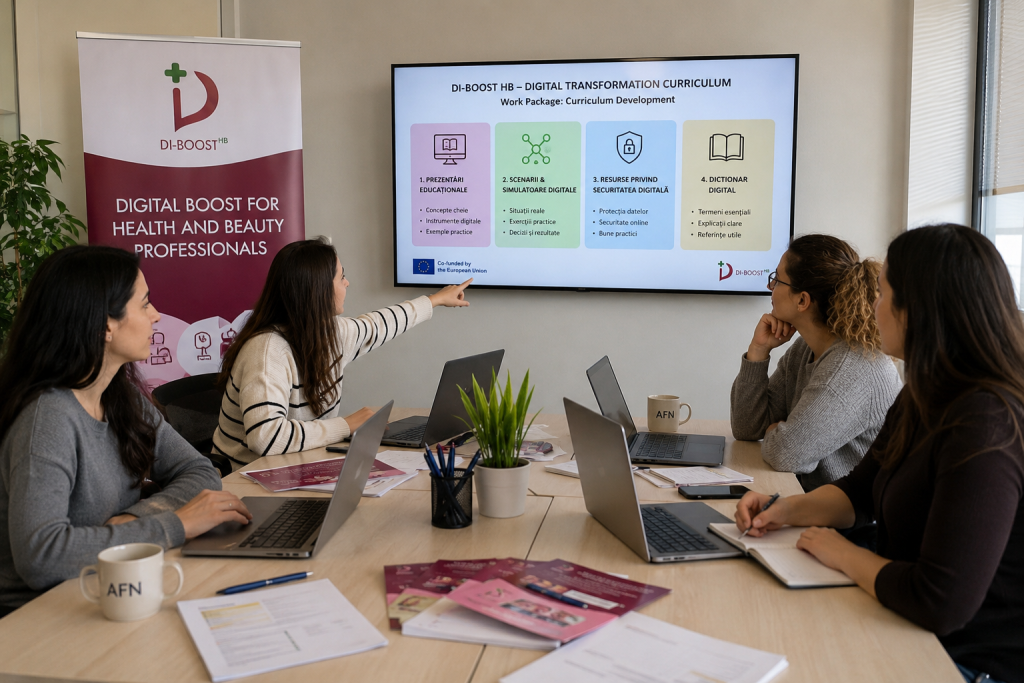
The Digital Boost for Health and Beauty Professionals – DiBoost-HB project has begun an important implementation phase dedicated to the development of the Digital Transformation Curriculum for Health and Beauty Professionals.
This work package is designed to create practical, accessible and sector-specific educational resources that will help professionals, students and trainers strengthen their digital competences and respond more effectively to the technological changes affecting the health, beauty and wellness sectors.
Project reference: 2025-1-PT01-KA210-VET-000357067
Purpose of the Work Package
The curriculum aims to support beauticians, hairdressers, spa professionals, wellness specialists, vocational students, trainers and unemployed people who need stronger digital skills to improve their professional opportunities.
The materials will address real situations encountered in daily work, such as communicating with clients online, managing appointments, promoting services through digital channels, protecting personal information and analysing business performance.
The work is structured into several development stages to ensure that the final curriculum is clear, practical and easy to use.
Stage 1: Educational Presentations
During the first stage, the participating organisations began preparing educational presentations connected to the main curriculum topics.
The presentations are intended to explain essential digital concepts in an accessible manner and provide examples relevant to health and beauty professionals. Contributions are being developed at national level, allowing the curriculum to reflect different professional environments and experiences from the participating countries.
These materials will provide the theoretical foundation for the more practical resources developed during the following stages.
Stage 2: Practical Scenarios and Digital Simulators
The second stage focuses on the creation of realistic scenarios and digital simulator examples.
These resources allow learners to practise professional tasks in a safe learning environment. Instead of studying digital tools only in theory, participants will be able to analyse situations, make decisions and observe the possible consequences of their choices.
The scenarios developed include areas such as:
- safe digital management of client information;
- creation and management of online client services;
- analysis of business performance data;
- use of digital tools in professional decision-making;
- identification of appropriate responses to common workplace challenges.
The simulator materials are designed with simple instructions so that they can also be used by learners with limited previous digital experience.
Stage 3: Digital Security Resources
Another central part of the curriculum is dedicated to digital security.
Materials are being developed to help professionals understand how to protect client data, use strong passwords, recognise online threats and apply responsible practices when using digital platforms.
The participating countries are contributing practical examples adapted to their national contexts. The resources address situations that may occur in salons, health services, beauty businesses, training centres and other professional environments.
The digital security component is particularly important because health and beauty professionals frequently manage personal information, appointments, contact details, photographs and other sensitive client data.
Stage 4: Digital Dictionary
The final planned stage includes the development of a digital dictionary containing important terms related to technology and digital transformation.
The dictionary will explain specialised concepts in clear and accessible language. It will support learners who may be unfamiliar with technical terminology and help them understand the language used in digital platforms, online marketing, cybersecurity, data management and specialised professional software.
This resource will make the curriculum easier to use independently and will provide participants with a practical reference tool for future learning.
Practical and Inclusive Learning
The curriculum is being developed with a strong focus on accessibility, practical application and inclusion.
The resources will combine presentations, case scenarios, simulations, explanations, digital security guidance and assessment activities. This variety will allow trainers to adapt the materials to different learning levels and professional backgrounds.
The final curriculum will support both guided training and self-directed learning. It will also be used during the project’s training course for trainers and practical national workshops.
Role of EDU TECH GRYPHON DISCOVERIES
EDU TECH GRYPHON DISCOVERIES Romania is leading the development of the Digital Transformation Curriculum and contributing to the preparation of digital, interactive and visually accessible educational materials.
The organisation is supporting the coordination of the different curriculum stages and the transformation of project content into practical learning resources. Its contributions include work on digital simulations, scenario-based learning, digital security and the general structure of the educational materials.
Expected Results
The work package will result in a comprehensive digital curriculum adapted to the real needs of the health and beauty sector.
The materials are expected to help learners:
- improve their confidence in using digital technologies;
- manage client information more safely;
- use digital platforms more effectively;
- understand digital marketing and online communication;
- make better use of business information and performance data;
- increase their employability and professional adaptability.
By combining knowledge with practical exercises, the curriculum will support the modernisation of vocational education and help health and beauty professionals integrate digital tools into their everyday work.
The resources will remain available after the end of the project, creating opportunities for continued training, replication and long-term impact across the participating countries.